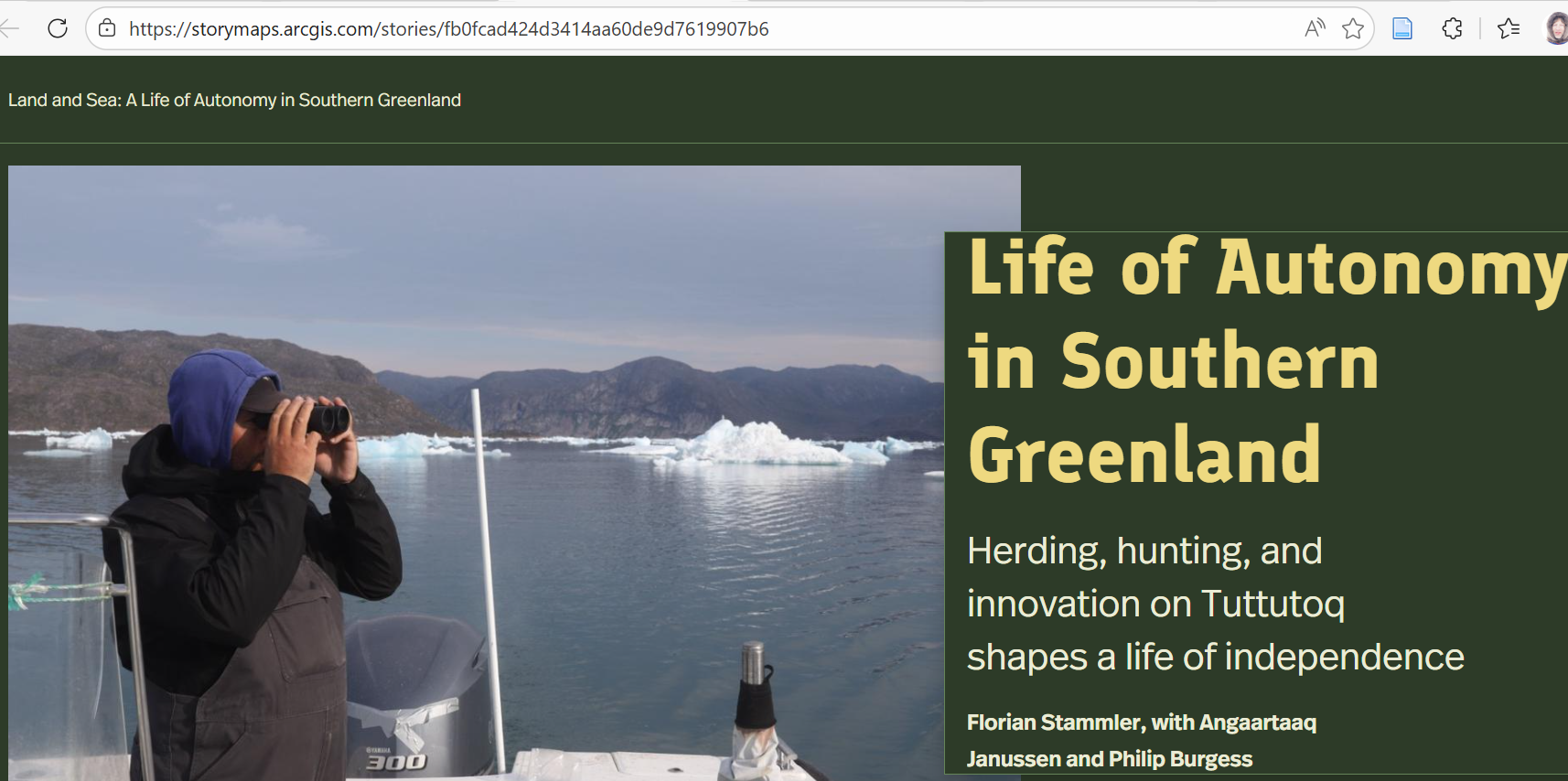
With all the difficult geopolitical news related to Greenland, the obvious anthropological gaze on autonomy is from the ground, based on people’s lived experience on land and sea. Together with Angaartaaq Janussen and Philip Burgess, we have tried to document such a unique story using multiple modes including text, sound, video and imagery, which you can read, listen, watch here:
Land and Sea: A Life of Autonomy in Southern Greenland
Some of our readers may remember the posts about Inuit innovation and the stony path to a field in 2024. What impressed there was people’s natural way of relating to their natural and social surroundings, living out their deep ways of knowing all species, beings and components of the land and sea surrounding them, and creatively carving out a way of live as part of a flexible whole. The whole system seemed like a big ball made of a breathable permeable soft shell, in which all components and beings – people included – move freely, changing their position and role depending on the situation.
Since 2022 I have spent time in different seasons with Greenland’s only full Inuit reindeer herder, Angaartaaq Janussen, from Tuttutoq island in South Greenland, at the fringes of the Kujataa UNESCO world heritage area. Angaartaaq embodies this kind of multi-being stewardship so impressively that an ethnography of his life alone allows for a deep understanding of what it means to live jointly with all beings that surround you. This is where autonomy is lived daily! I am deeply grateful to Angaartaaq and his family for having shared not only his story and narrative in words, but having let me so closely witness and participate in all skills that form a unique livelihood with the land and sea in South Greenland.
Several aspects about this are fascinating and curious from an anthropological point of view: firstly, this case is as unique as it is representative: since there is only one active Inuit reindeer herder in Greenland, when you know Angaartaaq’s case, you know all of Greenlandic Inuit reindeer herding:) . Across the fjord on the mainland there is also the reindeer of Stefan Magnusson, who runs the Isortoq reindeer station, nowadays engaging more in trophy hunting services. So it is these two very different trajectories that continued the destiny of domesticated reindeer – once brought alongside Sámi herders from Norway to teach Greenlanders how to herd reindeer (Cuyler 1999: 81). Secondly, as our multimodal story map shows, the ingenuity lies in combining the best of all the species surrounding people in South Greenland, rather than investing in just one “monoculture”. It is not new that diversification is a valuable way of risk management, as well as worthwhile for preserving diversity on our planet. But the easy-going way in which Angaartaaq does this impresses. The late Thomas Hyland Eriksen (2021) has outlined the consequences of the opposite – when everything in this world becomes homogenised. The multimodal ethnography of Angaartaaq’s life is a proof from the ground that it does not have to go this way. The way he engages with reindeer, sheep, fish, seals, and whales as well as the underlying water and land, is a celebration of multispecies diversity that encourages to think broadly, which we tried to capture in our multimodal storymap. The next step for Angaartaaq’s self-sufficiency is his plan to install a micro-hydropower station in one of the waterfalls on Tuttutoq – his island that is named after the Greenlandic term for reindeer.
 Arctic Anthropology