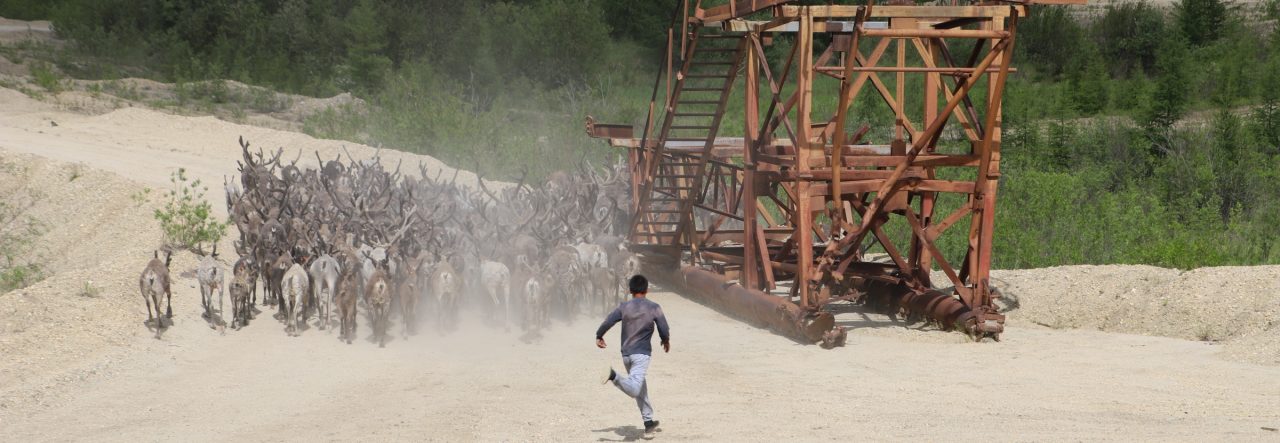
Finally the time has come for a separate blog post advertising and celebrating the publication of a book volume, for which more a dozen Arctic scholars have been waiting for six years: several of us were wrapping up a workshop at Tohoku University’s Center for Northeast Asian Studies (Japan), in 2019, where we discussed if there is something specifically “northern” about the relationships between humans and animals that are often subsumed under the difficult term domestication. We observed that several of those authors who presented there were making arguments in the same direction:
- domestication is not a one-off event, more a process;
- the distinction of what constitutes a “wild” and what a “domestic” animal is a human construct, while the realities are mostly less clear, and more fluid;
- these relations of domestication in the Arctic cannot be conceived of in isolation just between people and animals, but rather as part of a wider multi-species or “convival” (Anderson 2025) relationship ; and
- the North is not the only place to observe this, because comparing the experience in other extreme environments brings often similar insights.

The book is finally out, and open access in its entirety, at https://www.taylorfrancis.com/books/oa-edit/10.4324/9780367467401/benefits-cold-domestication-florian-stammler-hiroki-takakura . Below some observations on the different chapters:
After the initial workshop in Sendai in 2019, we got inspired to explore this line in greater detail, and got a generous grant from the Research Council of Finland “Fluid Realities of the Wild – WIRE“, which ended this August 2025. The book is at the same time one of the principal outcomes of that project.
Besides the chapter by David Anderson mentioned above, I would also like to celebrate especially the concluding chapter of the book by Hugh Beach. Not only for its innovative content that comparatively analyses domestication relationships concerning reindeer, wolves and also Sámi in Sweden. But also because this is, as the author told, probably the last major piece of scholarly text that he published in his career. Hugh Beach has been a principal figure in anthropology with the Sàmi since the 1970s. I think of him as one of the “magic triangle” of Arctic anthropologists working in three Arctic European countries: Hugh Beach in Sweden, Robert Paine in Norway, and Tim Ingold in Finland. Together, since the 1970s the three of them have had a tremendous impact on Arctic Anthropology in general for the next 40-50 years. So we are very honoured to have what Hugh Beach called his “final scholarly piece” in our volume.
It would not pay justice to all the great work the authors have put into their chapters, to provide simplified summaries here, so we invite you to explore the diverse chapters by all authors here , especially also by our Japanese colleagues who publish more frequently in their own language than in english, like Shiro Sasaki, Shiaki Kondo, Yuka Oishi, Takuya Soma and Asami Tsukuda. All of them are super inspiring, but I would like to highlight two short thoughts in this direction: in the Arctic and reindeer herding we have read so much recently about natural disasters and the consequences for pastoralists, e.g. through rain on snow events. Takuya Soma with his work in Mongolia shows that this is neither specific to the Arctic, nor is it new, as herders have long term indigenous ways of relating to and knowing such events. Yuka Oishi’s innovative work reminds us that in contemporary human-animal environment studies, not only should we revisit what is wild and what is domestic, but also what is a herbivore and what is a carnivore, as her research with Khanty reindeer herders feeding fish to herbivores shows.
Besides the principal theoretical advances in the volume, by each author in their own field, three chapters stand for me for a sort of innovative injection from slightly outside our usual intellectual engagements as Arctic anthropologists: the chapter lead-authored by Juha Kantanen is significant, because it shows that the findings of anthropologists’ work with herders turn out to be inspiring and meaningful even for “hard-core” natural scientists such as geneticists. Juha shows how a geneticist makes use of anthropological insights to shape genetic research agenda, interpret findings, work with herders jointly on data collection for animal-genetical research, and then contribute to similar theoretical endeavours as we anthropologists do, e.g. explaining domestication as a process. I am happy to have had the opportunity to work with Juha in our WIRE project and this chapter with him.
Another very unusual take on domestication comes from a direction of scholarship at first glance hardly related to the topic: legal studies. In Hugh Beach’s chapter we find that the way in which states govern the life of what they call domestic and wild animals, and in parallel indigenous peoples, is highly influential for the thriving or the collapse of these beings in the environment. In the chapter lead-authored by Aytalina Ivanova, we discover such ways of governing in detail, on the example of three signature domestic animals of the Sakha Republic (Yakutia): reindeer, horses and cattle. But just like in Hugh Beach’s piece, here too the people are not portrayed just as victims of inappropriate policies (we have seen that before…). Rather, we find out about their agency. To the extent that Ivanova applies the “domestication as process” idea beyond animals to legal anthropology: to show how laws not only shape people’s life, “domesticating”, streamlining and making their practice on the land better administrable – but also people “domesticating” their laws, meaning taking laws not as restricting their real lives, but making them fit to their needs, and finding ways to live with them, around them, in and above law.
Last but not least, anybody who thinks that all the Arctic domestication research speaks to itself too much, provincialising academic discourse: you are invited to explore the chapter by Asami Tsukuda. In her exceptional fieldwork with herders in the Andean highlands of Peru, she found the same fluidity of human relations to the wild and to the domestic among people who live with what people have categorised as both wild and domestic camelids: Llamas, Alpacas and Vicuñas. In her ethnography we can see how theoretical takes on domestication developed in the Arctic work just as well in other extreme environments: she shows human relations beyond “from trust to domination” (Ingold 2000), exploring “human and animal motivations entangled” (Stépanoff et al 2017, and this volume), in what Takakura (2010) has called a “subsistence continuum” , or Stammler (2010) “symbiotic domesticity” as a human-animal state of mind in the same volume, building on the first advancement in this sphere that we called practices of “symbiotic domestication” with Hugh Beach.
Therefore, we hope that this volume can speak not only to Arctic anthropologists, but also to scholars working with human-animal relations outside of anthropology (e.g. in genetics), and those outside of the Arctic working in other extreme environments.
Florian Stammler and Hiroki Takakura
 Arctic Anthropology