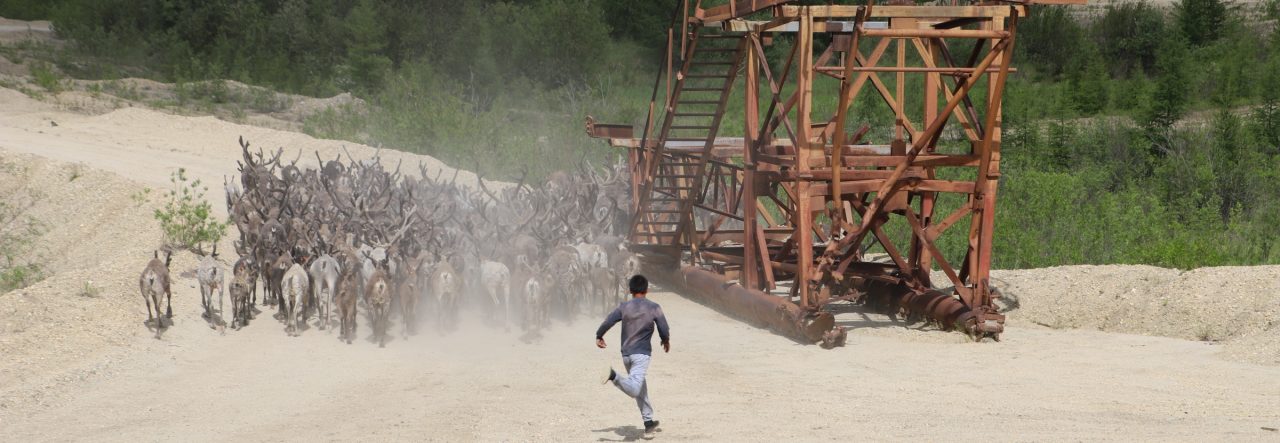
“Multimodal anthropology gives a name to something that many of us have actually been doing for long, but maybe as side projects”, says Christine Moderbacher, soon new Professor of multimodal anthropology at UiT in Norway. In this respect the 29 September 2025 made history in Arctic Anthropology: The Arctic University of Norway (Tromsø) opens a new degree in what is now called “Multimodal Anthropology”. Multimodal pays respect to the variety of practices by anthropologists and the people with whom they work, acknowledging that the making of anthropology always involves multiple modes of working: with fieldnotes, photos, audio, video, drawings, arts, and not just texts. This is now reflected in Tromsø’s decision to merge their anthropology and visual cultural studies masters programme into one masters in visual and multimodal anthropology.
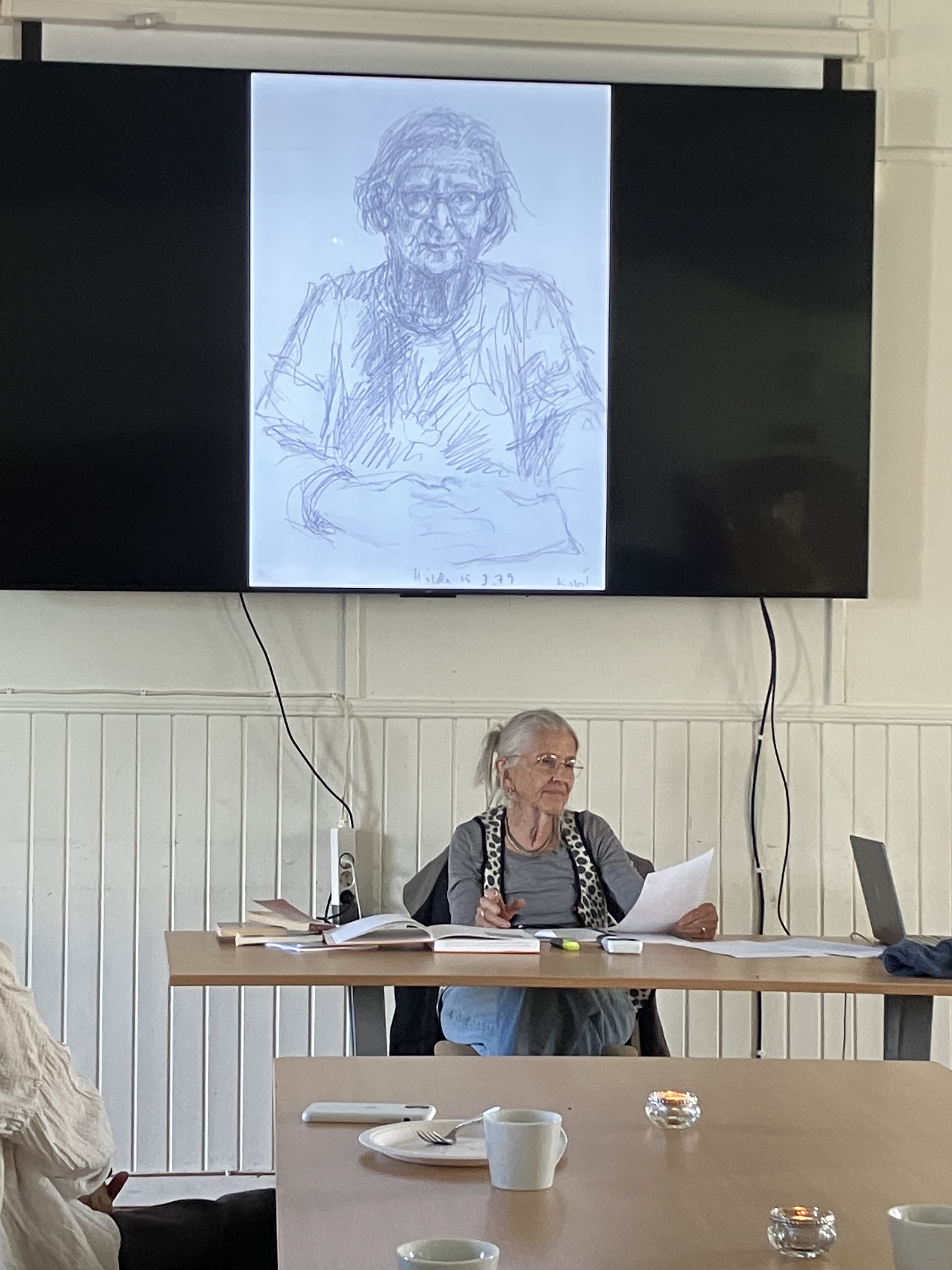
Lisbet Holtedahl, the founder of Tromso Visual Anthropology, bringing back some of her multimodal work to her field partners in Ersfjordbotn, North Norway 31 August 2025
At the celebration seminar in Tromsø, anyone could realise that even if we might not consider ourselves visual specialists, we actually employ multimodal methods as we make our anthropology with our field partners. In her opening speech, Prof Emerita Lisbet Holtedahl presented an impressive historical journey of what became the “Tromsø School” of anthropological film. That journey of making ethnographic documentaries started 30 years before a degree was actually offered.
The speakers at the seminar emphasize co-creation as one crucial building block not just in traditional anthropology, but also in film-making. Great visual anthropologists such as Holtedahl and Len Kamerling (UAF) have practiced this jointly with people in their fields from the 1960s onwards, way before the term of co-creation made it to the methodological agenda in anthropology. Holtedahl for example in the village of Ersfjordbotn in Northern Norway, and Kamerling on St Laurence Island between Alaska and Chukotka. We were happy to have these classical figures of visual anthropology at the seminar. And Professors Trond Waage and Richard Fraser can be congratulated of having established this degree on the base of such a tradition.
Their research also shows us the way of what our friend and colleague Piers Vitebsky in Cambridge calls “de-provincialising the Arctic”, because all of these colleagues continue working not “only” in the Arctic, but also the Global South, be it Cameroon, where they helped establishing visual anthropology at the University of Maroua (Cameroon), Niamey (Niger), or rural China. This means that Arctic wisdom becomes part of the global advancement of knowledge, as part of cross-cultural multimodal enrichment.
In her inaugural speech, Lisbet Holtedahl made a statement that caught my attention: “dissemination is an integral part OF the research, NOT an add-on AFTER the research”. Visual methods in anthropology, including but not limited to film, Holtedahl explains, are excellently suited for this in many arenas: for bringing our material back to the people with whom we work; for letting the world know about our work, partners and topics, and also as a lobbying tool for funding acquisition. In her presentation, Christine Moderbacher reminds of the article “Multimodality: an invitation (2017)“, which emphasizes a similar argument: multiple modes of engaging with various audiences, for which our anthropological results are meaningful (or should be), have changed, towards (1) more democratic media production (2) more natural collaboration with field partners, and (3) emphasizing our dynamic role between our profession as anthropologists and the people we work with.
But I wonder did it really change in principle? In their presentations, both Holtedahl and Kamerling showed they have actually made multimodal anthropology as early as 1970, in what Kamerling calls sharing of decision making.
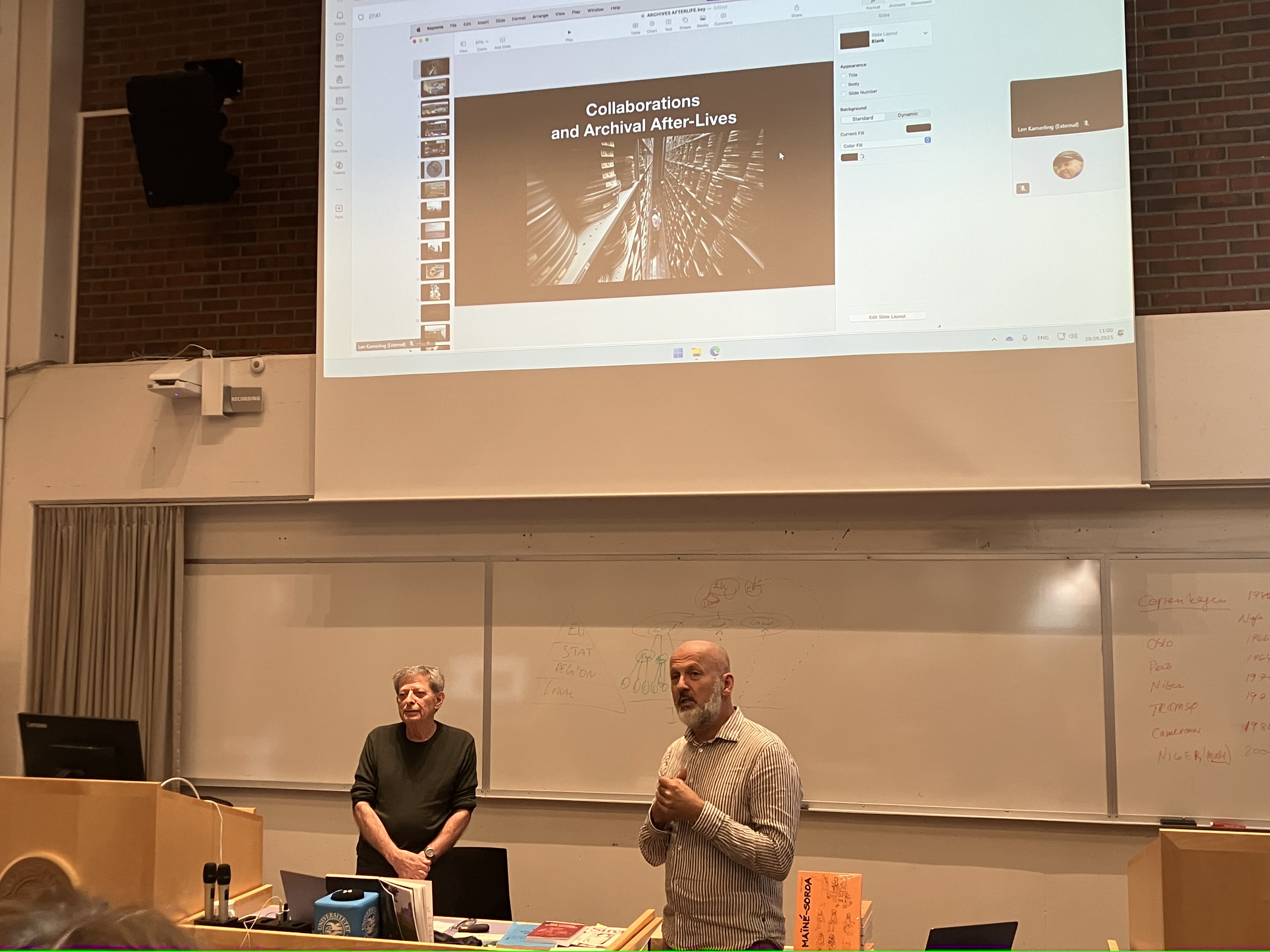
Len Kamerling (left) and Trond Waage (right) at the multimodal anthropology celebration seminar, Tromsø
Kamerling told how he went to a remote community by the Bering Strait for making a film, inspired by Asen Balicki’s work on the Netsilik: he thought he would start the shared decision making during a community meeting – without success: nobody would speak anything at the meeting. That experience threw over his methodology developed at the university. Probably most of us have encountered something like that: we go with these sophisticated models designed from a desktop, and then as soon as we arrive to the field it’s a mess, and none of it works.
The second new professor in Tromso, Mihai Leaha, while not having worked in the Arctic, takes collaboration in his work with queer people in Brazil one step further, to shared authorship. This is for example the case when people in the field make their own video-diaries on their phones, and then send it across to the anthropologist/film maker, where the material gets edited into a film. Digital and mobile communication makes this possible, even across closed borders: we are currently trying this with our partners in Siberia, also due to the inaccessibility of the field there. Leaha highlighted that anthropological journals that have been traditionally exclusively text-based follow that multimodal turn, nowadays allowing for multiple ways of presenting anthropological knowledge, including film. His recent article in cultural anthropology with embedded film content is an example.
In lecturer Marte Aasen‘s presentation, we got a rare glimpse of the world of editing – an incredible job that is mostly in the background, as all the credit goes to the director and co-authors. But editing is an demanding process, where the editor needs to start feeling the footage, meet the characters on the screen, and embrace the story of the film, without necessarily having been there nor knowing the people in person.
With all this, some wonder about the difference between documentary and ethnographic film, (as well as the difference between anthropology and journalism). In the last speech of the day, new lecturer Alessandro Belleli put this struggle likt this: “As anthropologists we often diasgree with the documentary filmmaking industry, but (more) often we do without knowing that we actually don’t”. This means navigating the thin margin in making your material accessible for a broader audience, who often want intimacy, emotions on the one side, and academic circles with their focus on complexity, the fundamentals of humanity and keep the conversations going on the other side.
But in navigating these margins, the future of multimodal anthropology, as Leaha summarises, is collaborative, experimental and decolonial at the same time. Congratulations to all colleagues of the Tromso department for the achievements, and for what looks like a great future of fused anthropology! We look forward to fruitful North to North cooperation in northernmost Europe between enthusiastic colleagues.
 Arctic Anthropology