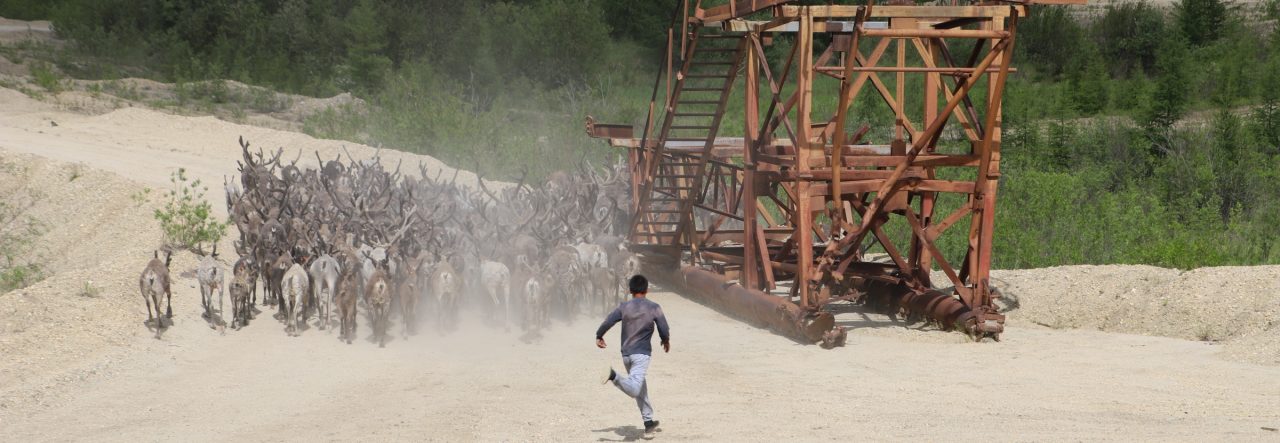
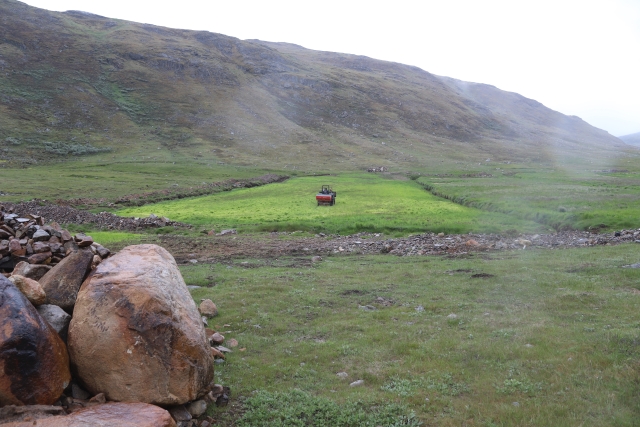
Some may remember our entry here with Erik Kielsen about the disastrous early snowfall and freezing event in South Greenland in late 2023. This summer fieldwork in the WIRE project there is on the occasion of the 100th anniversary of modern Inuit animal husbandry, and I am hosted at the Qorlortup Itinnera sheep farm, which has a guest house, by Tupaarnaq Kreutzmann Kleist and Aaqqioq Kleist. Therefore our blog will feature some more entries on this fascinating and very innovative Inuit culture of animal husbandry, about which there is almost nothing written in the anthropological literature. As the season has it, in the summer the sheep graze on their own on the mountains between the southern tips of the Greenland ice sheet and the coast.
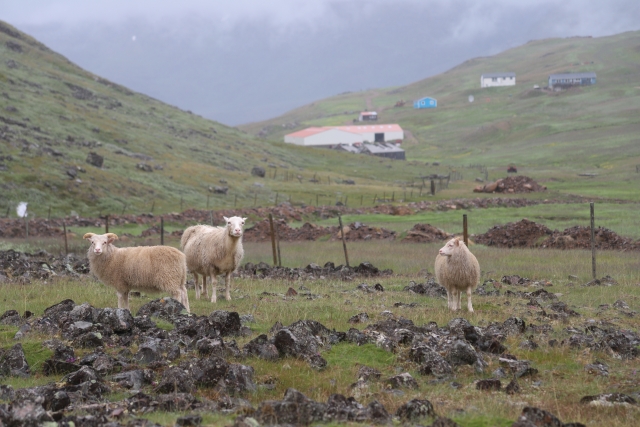
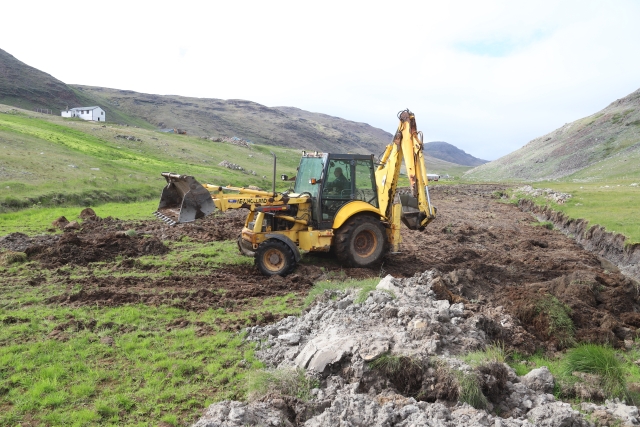
In the lowlands, the farmers fence off patches of land where they grow hay for the winter for their sheep. But not only is summer the time of hay-making. Preceding that has is field work as literally as it gets: working with your own hands on the field, in order to prepare the land for growing hay, which nowadays is moved by tractor and rolled up in bales and wrapped in plastic like elsewhere. But that field work is first and foremost a stony process – again quite literally: the soil dynamics in South Greenland has it that the land moves, and rocks raise from the ground in regular intervals. In order to keep a field viable for producing hay, these rocks need to be removed, which is mostly a manual operation: only big boulders heavier than a person can lift are removed by tractor. The rest of the rocks we remove by hand, sometimes using a heavy iron pole as a tool to dig them out from half under the ground. On a field that can extend several hundred meters in length, this is a process of many person-days of work. As a first step, a tractor goes through the field and digs out larger rocks that stick out of the ground.
As a result of this big rock digging, the tractor uncovers 100s of smaller rocks that disturb the planting and harvesting hay process later. We need to gather such rocks by hand in visible piles,
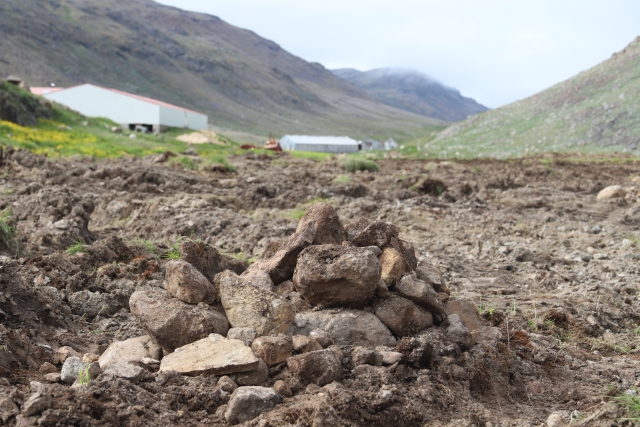
and then as a second step load them to the showels of tractors that transport them outside the field, where they form huge piles that don’t disturb hay making.
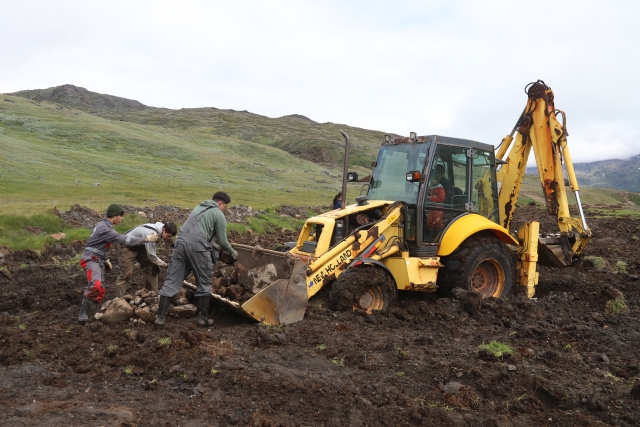
In this physically hard, slow and tedious process, I realise that this is the most literal “field work” I have every made. It is also very different from the previous fieldwork in human-animal relations in the Arctic that we work on in our current WIRE project. With hunters or herders in most of the Arctic, field work involves living with people and animals on the land, but rarely if at all actually digging into the land with your own hands, and uncovering rocks from half underground. May this be one of the reasons that the Inuit that keep sheep in this challenging landscape in South Greenland are called sheep farmers, and not sheep herders? Although they also herd the sheep in the fall back to their homesteads using horses and dogs – like many other herders.
What is a stone ? Reading the land with your body
Doing this field work, you learn about the land very differently and in much detail: the different soil textures and colours, and the different kinds of stones in the ground. Gradually you acquire skills, from the very basics of distinguishing what is a stone. Because sometimes there is clay that is rather solid and looks like a stone. Only once you know it and don’t hear a sound, you realise that this is soft matter, which does not need to be removed from the earth. So this literal field work teaches the worker essential features of the land, you learn reading the field, with your eyes, your hands and feet and ears. Much the way in which phenomenology promotes the body as a tool for experience – and here quite the entire body, all the way to physical exhaustion. Nietzsche had rejected the mind-body dualism. Here in the field literally, the thoughts are guided by this bodily experience: we do this work ultimately for feeding sheep through the harsh Greenlandic winter. Do the sheep realise how much effort goes in to feeding them? Not very likely, says my host Tupaarnaq Kreutzmann Kleist.
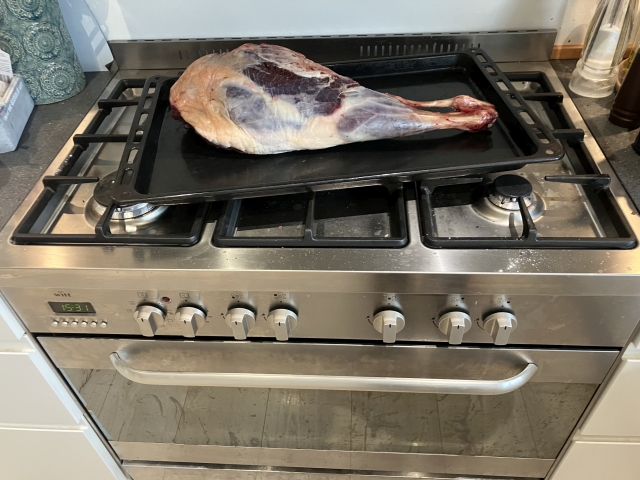
Later when we have a most delicious meal of sheep, a culinary masterpiece by Tupaarnaq, the body feels that meat differently from before that stony field work. Hunted meat is also ‘hand-made’ of course, but here not only was the animal fed by a natural pasture, and by hay from a field, but even the land that gave rise to that field was worked by hand. A very existential experience from hand to mouth!
On this very land the vikings had practiced animal husbandry 1000 years ago. Next week we are going to celebrate the 100th anniversary of contemporary Inuit sheep husbandry (would you like to call it herding or farming?). This is also a good occasion to raise the profile of this very innovative way of relating to the land, culturally very specific, and with some surprising lessons for many of us to learn in a changing climate. In the next entry we are going to write about some of these lessons from Greenlandic innovation for the future with my host Tupaarnaq Kreutzmann Kleist.
 Arctic Anthropology